
I thought I’d write about something a little more specific.
I talk about my experiences in fitness, weight loss and running, but I’ve shared very little about how I’ve actually trained for some of my races.
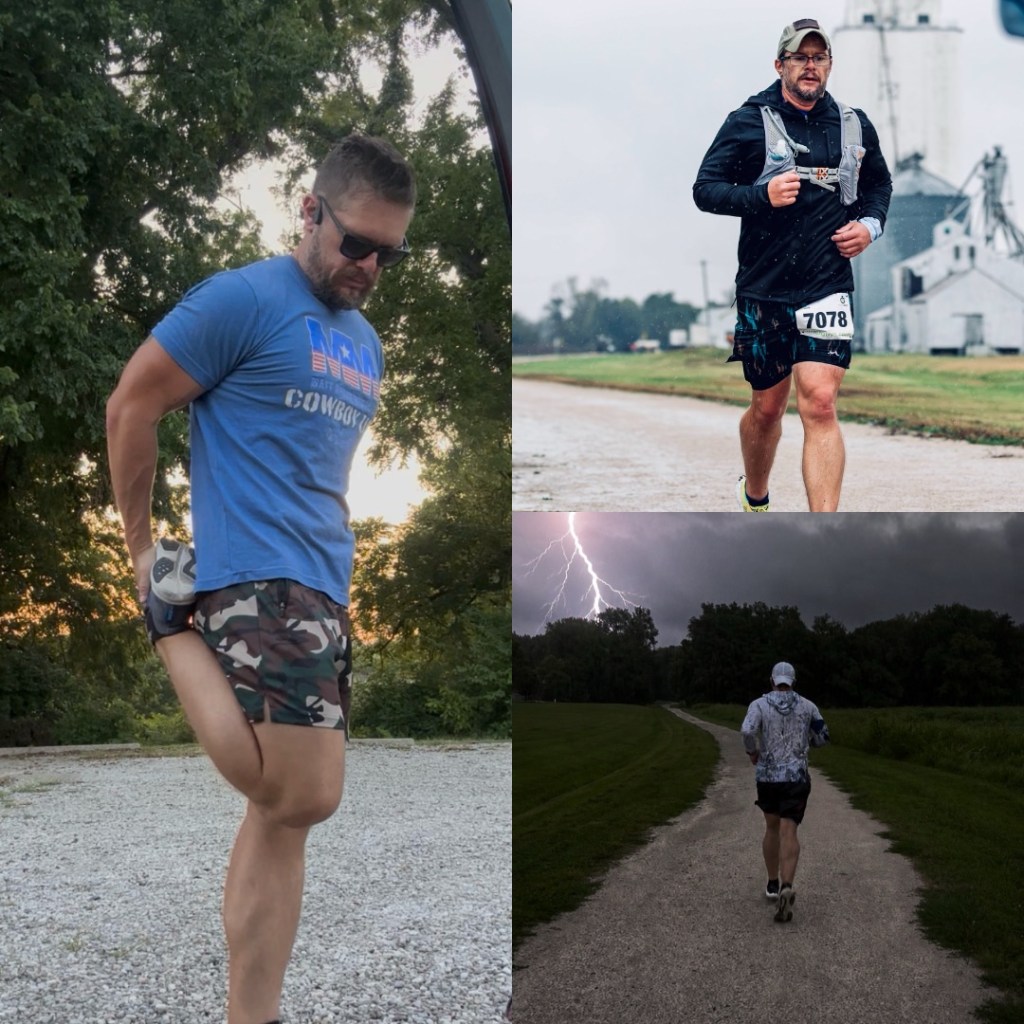
Today, it’s exactly six weeks from the Hennepin 100 (a 100-mile ultramarathon in Illinois).
I’m no stranger to ultras and trail running. I’ve got a couple 50-milers, a handful of 50Ks, and full marathons under my belt. But Hennepin will be my longest race to date.
And honestly, it still feels ambitious.
Fresh off my recovery week from a 50K, I’m starting a six-week training block that will carry me to the starting line of my first 100-miler.
For the next four weeks, my running mileage will climb higher than it has in the past, but in a controlled environment. Then a two week taper.
One of the biggest components will be back-to-back medium and long runs.
Why?
Because I intentionally don’t want to be completely recovered when I start the next long run.
For example, I may run 15 miles on Monday and then turn around and run another 15 miles on Tuesday.
The second 15 miles isn’t supposed to feel like the first.
That’s the point.
Running on tired legs is excellent preparation for an ultramarathon because, eventually, a 100-mile race is going to become a contest between what your body wants to do and what you’re demanding it to do.
There’s another important part of my training that I think is often overlooked:
Pace isn’t the goal.
It’s tempting to go out for a run thinking, “I want to run this at a sub-9-minute pace.” (Or whatever pace I decide is “impressive” at that moment)
And there’s absolutely a place for pace focused training.
But when every run becomes a race against the clock, you leave some of the intended training benefit on the table, and potentially increase fatigue and injury risk.
For many of my runs, I’m more interested in my heart rate than my pace.
I use heart rate zones to control the intensity of the workout. Rather than deciding beforehand that I must run a certain pace, I decide what physiological effort I want to train and then adjust my pace accordingly.
Interestingly enough, the effort I give for certain paces change day to day. I may average a sub 130 HR at a 9:15 minute pace one day but then the next a 10:15 pace pushes my HR above 145. A lot of factors can influence this; weather, elevation gain, hydration, sodium intake, fueling (carb load, calories, etc), blood sugar, sleep, training load, etc.
Therefore, to achieve a specific HR zone I often have to adjust my pace accordingly.
Specific example:
Let’s say I go out for four miles.
Maybe I average an 8:30 pace, but my heart rate climbs well above the zone I intended to train in.
That run may be faster, but it wasn’t necessarily a better training session.
On another day, I might run those same four miles at a 10:30 pace while keeping my heart rate exactly where I wanted it.
That can be the bigger win.
Why?
Because the purpose of the workout wasn’t to prove how fast I could run four miles.
The purpose was to train a specific physiological system at a specific intensity.
That’s one of the things I find fascinating about endurance training.
I’m not just going out and thinking, “I need to get X number of miles done as fast as possible.”
I’m asking myself:
What adaptation am I trying to create today?
Am I working my base aerobic system, VO2 Max, tempo pace, threshold pace, high anaerobic systems?
Sometimes that means running faster.
Sometimes it means running farther.
And sometimes it means slowing down considerably, even when I know I could go faster.
Training for 100 miles isn’t about proving that I can run a sub 2 hour half marathon every time I train.
It’s about putting together enough small, intentional adaptations that, when race day comes, my body is prepared for the enormous task I’m asking it to accomplish.
Six weeks to go.
Let’s see what happens. 🏃♂️💪🔥
Andrew Frizzell | Iron Will Weight Loss
Discover more from Iron Will
Subscribe to get the latest posts sent to your email.

